

The essential answer
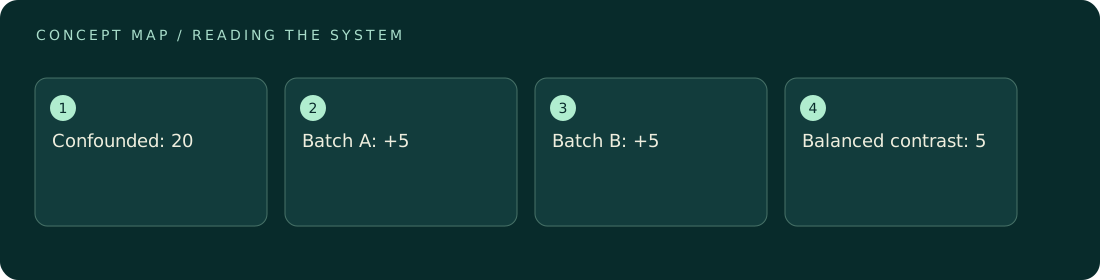
If every illustrative control is measured in batch one and every treated sample in batch two, a 20-unit difference cannot distinguish treatment from a 20-unit batch shift. A balanced follow-up with both conditions in each batch can separate the two under an additive model. In the constructed example, within-batch treatment effects are both 5 units even though the batches differ by 20 units. More repetitions of the confounded layout would not resolve that ambiguity.
How to reason about it
Write response as baseline plus treatment contribution plus batch contribution plus residual error. When treatment status perfectly predicts batch, the treatment and batch columns of the model contain the same information. No fitting method can recover their separate effects from that design alone without additional assumptions or evidence. Blocking places both conditions within each batch so that within-batch differences cancel an additive batch offset. Randomization within blocks helps protect against other systematic ordering effects. This does not guarantee that all batch effects are additive: a treatment-by-batch interaction can make the treatment difference vary across batches. The official NIST source provides the blocking principle. The invented values below isolate the algebra; they are not cell measurements or evidence for a biological intervention.
ILLUSTRATIVE · NOT A REPORTED RESULT
An example to work through
First consider illustrative controls with mean 100 units in batch A and treated samples with mean 120 in batch B. The observed difference is 120−100=20. One explanation is treatment=20 and batch=0; another is treatment=0 and batch=20; a third is treatment=5 and batch=15. Each predicts the same two means. Now create a balanced illustrative dataset: batch A control=100 and treated=105; batch B control=120 and treated=125. Within A, the treatment contrast is 105−100=5. Within B, it is 125−120=5. The mean treatment contrast is (5+5)/2=5 units. The average batch B response is 122.5, while batch A is 102.5, a 20-unit batch difference. Overall treated mean is 115 and control mean is 110, again a 5-unit difference. This balanced construction resolves the additive contrasts, but two batch-level contrasts still provide limited information about variability across a wider population of batches.
Where interpretation fails
Including batch as a software covariate does not repair perfect confounding: the missing comparisons remain missing. Likewise, applying a batch correction learned from the same confounded data can remove true treatment signal or preserve artifact depending on assumptions. A numerical output is not evidence that the effect was identified.
The next decision
For the original layout, describe the 20-unit contrast as a combined treatment-and-batch difference. For the balanced example, the 5-unit within-batch contrast is interpretable under the additive assumptions. Inspect whether treatment differences vary by batch before extending the conclusion to conditions outside the represented batches.
Sources & context
These sources support the concepts noted below. Our synthetic examples and research framing are educational interpretation; they are not findings from these organizations or validation of our ventures.
- NIST: Randomized Block Designs ↗
Blocking separates an investigated factor from controlled nuisance factors.
Source check: Definition and rationale read
Educational research context, not a validated device specification or clinical protocol. Read our editorial and correction policy.